
Caffeine
This page is a reference summary of published evidence and regulatory documents. It is not a substitute for individual medical advice, and it is not a recommendation to take or avoid any medicine.
Medically reviewed by Dr. Sofia Lindqvist, · Last reviewed 11 August 2026
Caffeine is the most widely consumed psychoactive substance in the world. It is on this site for two reasons: it is a genuine pharmacological stimulant with a substantial research literature, and it is the realistic baseline against which the prescription wakefulness agents should be compared.
For most people considering a wakefulness medication, the honest comparison is not against nothing. It is against the coffee they already drink.
On this page
How it works
~5 h
average half-life
2–10 h
range between individuals
30–60 min
time to peak
~300 mg
three cups of coffee
Adenosine builds up in the brain across waking hours and is one of the principal signals producing sleep pressure — the mounting tiredness of a long day.
Caffeine is structurally similar enough to adenosine to occupy its receptors without activating them. It does not reduce adenosine or reverse the underlying process. It blocks the perception of it. Downstream, this permits increased dopamine and norepinephrine activity, but the primary action is receptor blockade.
Adenosine accumulates
sleep pressure rises
Caffeine occupies receptors
no activation
Signal not perceived
alertness maintained
Caffeine clears
full signal arrives at once
Caffeine hides the signal rather than clearing it. The build-up continues underneath, which is why the drop is felt so sharply.
This is a completely different mechanism from every prescription drug on this site. None of them act on adenosine.
Pharmacokinetics
Peak plasma concentration occurs roughly 30 to 60 minutes after ingestion. The half-life averages around five hours but varies enormously between individuals, from about two to ten, influenced by genetics, smoking status, pregnancy and hormonal contraceptive use.
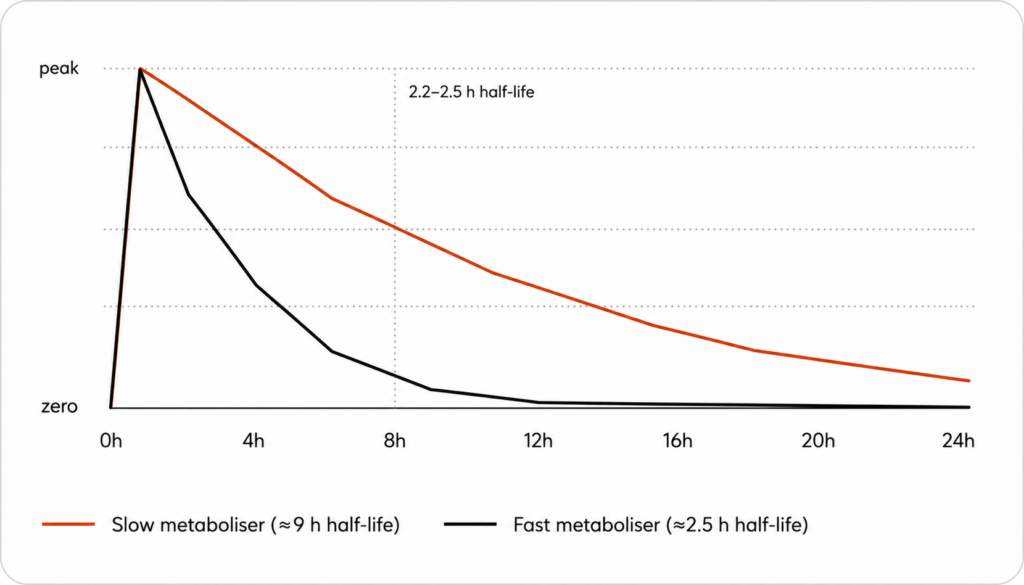
The same 150 mg dose at 15:00 in a fast and a slow metaboliser. The two people are not having the same experience of the same coffee.
That variability is why personal experience with coffee timing does not transfer reliably to other people, or to other drugs.
Tolerance and withdrawal
Tolerance develops quickly and is well documented. Regular consumers get substantially less alerting effect than occasional users at the same dose.
Physical dependence is common, and withdrawal is well characterised: headache, fatigue, irritability and difficulty concentrating, typically starting 12 to 24 hours after the last dose.
One consequence deserves stating plainly. Much of what habitual coffee drinkers experience as caffeine’s benefit is partly the reversal of overnight withdrawal rather than enhancement above a true baseline.
Effects on sleep
Given the half-life, an afternoon dose is still meaningfully active at bedtime. Caffeine reduces slow-wave sleep and increases sleep onset latency, and it does so even in people who report no subjective difficulty falling asleep.
Compared with prescription wakefulness agents
Head-to-head trials exist, which is unusual. In sleep-deprived subjects, both caffeine and modafinil significantly outperform placebo on vigilance measures. The difference appears later in the dosing interval, where modafinil’s longer half-life sustains the effect after caffeine has declined.
Combining caffeine with prescription stimulants
Caffeine adds to the cardiovascular and anxiogenic load of any prescription stimulant without a corresponding gain in benefit.
Espresso, single
63 mg
Brewed coffee, one mug
100 mg
Energy drink, 500 ml
160 mg
Three cups of coffee
300 mg
Typical caffeine content, against the 300 mg dose used as an active comparator in modafinil trials.
The most common practical error is not counting it. Three cups of coffee is not background. It is a second active stimulant at a research-grade dose. Anyone starting a prescription wakefulness agent should discuss their actual caffeine intake with the prescriber rather than treating it as irrelevant.
How long does caffeine stay in the body?
The half-life averages about five hours but ranges roughly from two to ten between individuals, influenced by genetics, smoking, pregnancy and hormonal contraceptive use.
Is a caffeine crash real?
Adenosine keeps accumulating while its receptors are blocked. When caffeine clears, the accumulated signal is felt at once. That is a large part of what the crash actually is.
Can I drink coffee on modafinil or a stimulant?
It adds to the cardiovascular and anxiogenic load without a matching gain in benefit. Three cups is roughly 300 mg — the same dose used as an active comparator against modafinil in trials. Discuss your actual intake with the prescriber.