
Home / Comparisons / Adderall vs Vyvanse
Adderall vs Vyvanse
This page is a reference summary of published evidence and regulatory documents. It is not a substitute for individual medical advice, and it is not a recommendation to take or avoid any medicine.
Medically reviewed by Dr. Sofia Lindqvist, · Last reviewed 11 August 2026
Both are amphetamines. The difference is that Vyvanse is a prodrug, inactive when swallowed and requiring conversion in the body before it does anything. That single design feature produces everything else: slower onset, longer and smoother duration, less pronounced peaks, and a lower practical abuse liability, since the drug cannot be made to act faster by crushing, snorting or injecting it.
On this page
Side by side
| Adderall | Vyvanse | |
|---|---|---|
| Active drug | Mixed amphetamine salts | Lisdexamfetamine |
| Prodrug | No | Yes |
| Becomes active | Immediately on absorption | After enzymatic conversion in the blood |
| FDA approval | 1996 (IR), 2001 (XR) | 2007 |
| Approved for | ADHD, narcolepsy | ADHD, binge eating disorder |
| Onset | 30 to 60 minutes | 1 to 2 hours |
| Duration | 4 to 6 hours (IR), about 12 (XR) | 10 to 14 hours |
| Dose form | Tablet (IR), capsule (XR) | Capsule, chewable |
| Scheduling | Schedule II | Schedule II |
| Boxed warning | Yes | Yes |
How the prodrug works
Vyvanse is lisdexamfetamine, dextroamphetamine chemically bonded to the amino acid lysine. In that bonded form it is pharmacologically inactive. Conversion happens in the blood, where enzymes cleave the lysine and release dextroamphetamine. Because this depends on an enzymatic process rather than absorption alone, the rate of conversion is relatively constant regardless of how the drug is taken.
Lisdexamfetamine swallowed
Inactive as such
Absorbed into the blood
Still inactive
Enzymes cleave the lysine
Rate limiting step
Dextroamphetamine released
Now pharmacologically active
Methylphenidate: reuptake blockade only.
Amphetamine does that too, then goes further: it reverses transporter direction, actively pumping neurotransmitter out of the neuron into the synapse, and disrupts vesicular storage via VMAT2, releasing stored neurotransmitter into the cytoplasm where it becomes available for reverse transport.
Amphetamine enters the neuron
Crosses the membrane and enters vesicles
VMAT2 disrupted, vesicles empty into cytoplasm
Stored neurotransmitter is released
Transporters run in reverse
Neurotransmitter actively pumped into the synapse
Vyvanse requires enzymatic conversion before it becomes active, which caps the rate at which dextroamphetamine can appear regardless of route.
Crushing a Vyvanse capsule, dissolving it, or attempting to insufflate or inject it does not speed up conversion, because the rate limiting step happens after the drug is already in the bloodstream. Rapid onset is a primary determinant of a drug’s reinforcing efficacy, and Vyvanse’s design removes the ability to produce one. Adderall, by contrast, is active as swallowed; immediate release tablets can be crushed for faster onset, which is why the immediate release formulation has the higher misuse profile of the two.
Onset and duration in practice
Vyvanse takes one to two hours to take effect and lasts ten to fourteen hours. Adderall IR takes thirty to sixty minutes and lasts four to six. The clinical implication is about the shape of the day rather than the total effect.
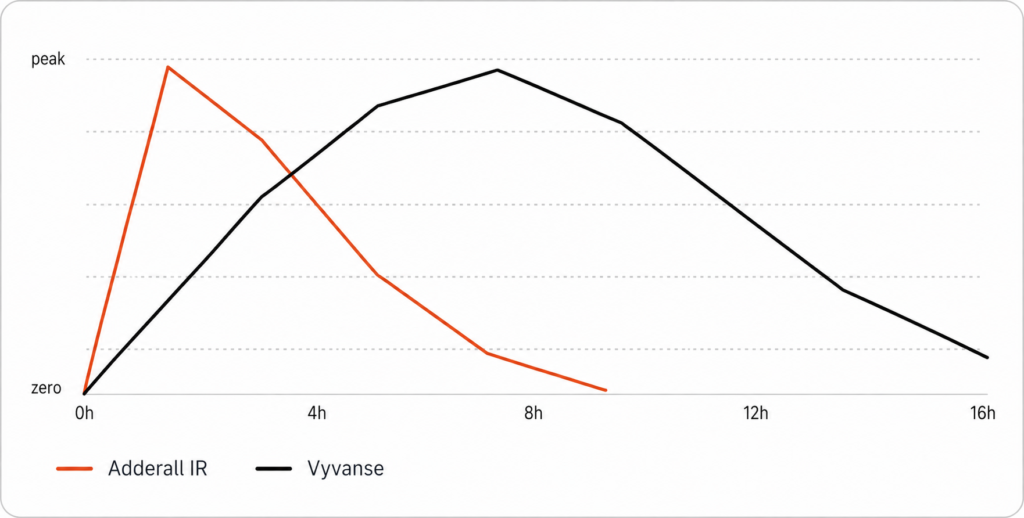
Illustrative plasma concentration curves. Vyvanse rises and falls gradually; Adderall IR peaks faster and falls off more sharply.
Vyvanse gives a gradual rise, a long plateau and a gradual decline, which many patients find easier to tolerate and which produces a less noticeable end of dose drop. Adderall IR gives a faster onset and a more defined offset, offering more control over timing but producing the peaks and troughs many patients report as the harder part of stimulant treatment. Adderall XR sits between the two.
Adderall IR
0–5 h
Adderall XR
0–12 h
Vyvanse
0–13 h
0h
4h
8h
12h
16h
Approximate duration of effect by drug and formulation.
Vyvanse’s long duration is a disadvantage where a shorter effect is wanted; taken late it can interfere with sleep well into the evening.
Approved uses
Adderall is approved for ADHD and narcolepsy. Vyvanse is approved for ADHD and moderate to severe binge eating disorder in adults, and does not carry a narcolepsy indication. For narcolepsy specifically, Adderall is the amphetamine with the approval.
Abuse liability
Both Schedule II with boxed warnings. Vyvanse’s prodrug design lowers the practical risk of misuse by non oral routes and reduces the potential for a rapid euphoric onset, which is why it is sometimes preferred where misuse or diversion is a specific concern. It is not abuse proof; taken orally at high doses it delivers dextroamphetamine, and dependence remains possible. The design reduces one pathway to misuse rather than eliminating the risk.
Cost
Adderall has long been available as a generic. Generic lisdexamfetamine became available more recently, and pricing varies by market and insurance. Historically cost has favoured Adderall, though the gap has narrowed.
Which a prescriber might choose
Vyvanse tends to be favoured where a smooth full day effect is wanted, where end of dose rebound has been a problem, where misuse or diversion is a concern, or where the patient has struggled with the peaks and troughs of immediate release stimulants. Adderall tends to be favoured where more control over timing is wanted, where a shorter duration is preferable, for narcolepsy specifically, and on cost grounds.
Is Vyvanse harder to abuse than Adderall?
Vyvanse’s prodrug design lowers the practical risk of misuse by non oral routes and reduces the potential for a rapid euphoric onset, because conversion depends on an enzymatic process rather than absorption alone. It is not abuse proof; taken orally at high doses it still delivers dextroamphetamine, and dependence remains possible.
Why does Vyvanse take longer to work than Adderall?
Vyvanse is lisdexamfetamine, which is pharmacologically inactive until enzymes in the blood cleave the lysine and release dextroamphetamine. That conversion step delays onset to one to two hours, compared with thirty to sixty minutes for Adderall, which is active as swallowed.
Can Vyvanse be used for narcolepsy?
No. Vyvanse is approved for ADHD and moderate to severe binge eating disorder in adults, but it does not carry a narcolepsy indication. Adderall is approved for both ADHD and narcolepsy.
Which is cheaper, Adderall or Vyvanse?
Adderall has long been available as a generic. Generic lisdexamfetamine became available more recently, and pricing varies by market and insurance. Historically cost has favoured Adderall, though the gap has narrowed.