
Home / Comparisons / Modafinil vs solriamfetol
Modafinil vs solriamfetol
This page is a reference summary of published evidence and regulatory documents. It is not a substitute for individual medical advice, and it is not a recommendation to take or avoid any medicine.
Medically reviewed by Dr. Sofia Lindqvist, · Last reviewed 11 August 2026
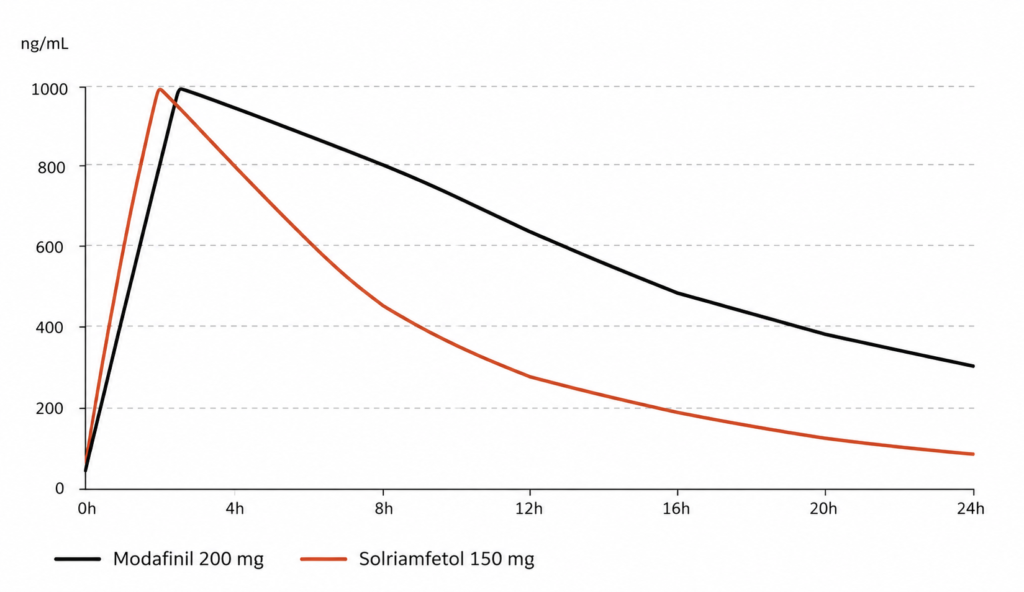
Both are approved for excessive daytime sleepiness in narcolepsy and obstructive sleep apnea. Modafinil has twenty five years of clinical use behind it and is usually tried first. Solriamfetol was developed specifically for patients who remain sleepy on existing treatment. The most practically useful differences are clearance route and duration: modafinil is cleared by the liver over roughly fifteen hours, solriamfetol by the kidneys over roughly seven. That single fact drives most of the clinical reasoning about which to use.
On this page
Comparison table
| Modafinil | Solriamfetol | |
|---|---|---|
| Brand | Provigil | Sunosi |
| FDA approval | 1998 | 2019 |
| Class | Eugeroic | Dopamine and norepinephrine reuptake inhibitor |
| Mechanism | Weak dopamine reuptake inhibition plus orexin and histamine effects | Dopamine and norepinephrine reuptake inhibition |
| Approved for | Narcolepsy, OSA, shift work disorder | Narcolepsy, OSA |
| Cataplexy | No effect | No effect |
| Standard dose | 200 mg once daily | 75 mg narcolepsy, 37.5 mg OSA, max 150 mg |
| Half life | About 15 hours | About 7 hours |
| Time to peak | 2 to 4 hours | About 2 hours |
| Cleared by | Liver, CYP3A4 | Kidneys, minimally metabolised |
| Dose adjustment driven by | Hepatic function | Renal function |
| Scheduling | Schedule IV | Schedule IV |
| Shift work disorder | Approved | Not approved |
Mechanism
Solriamfetol is a dopamine and norepinephrine reuptake inhibitor. The closest widely known drug by mechanism is bupropion, the main difference being bupropion’s additional action at nicotinic receptors, which solriamfetol lacks. Modafinil also inhibits dopamine reuptake, but weakly, and much of its effect appears to come from downstream activation of orexin and histamine systems rather than transporter binding alone. Solriamfetol’s precise mechanism for improving wakefulness is not fully established; efficacy is thought to be mediated through its reuptake inhibition. In practice solriamfetol acts more directly on catecholamine reuptake, while modafinil works through a broader and less well characterised set of pathways.
The clearance difference
This is the difference that matters most clinically, and it runs in opposite directions. Modafinil is metabolised hepatically via CYP3A4; in severe hepatic impairment clearance drops by roughly sixty percent and the label directs halving the dose. Solriamfetol is minimally metabolised and excreted renally as unchanged drug, so kidney function determines exposure. For a patient with significant liver disease, solriamfetol avoids the problem modafinil creates; for reduced kidney function the reverse applies.
The second consequence is drug interactions: modafinil induces CYP3A4 and inhibits CYP2C19, producing a substantial interaction list including hormonal contraceptives, cyclosporine and warfarin, while solriamfetol has a considerably simpler interaction profile. For a patient on multiple medications that is a meaningful advantage.
Duration
Seven hours against fifteen is a large difference. Modafinil’s longer half life covers a full working day from a single morning dose and is why it holds approval for shift work disorder; the cost is that a dose taken late in the day is still active at bedtime. Solriamfetol’s shorter half life makes it easier to avoid disrupting sleep and easier to reverse a dosing error; the cost is that it may not cover a long day or an extended shift, and it does not carry a shift work disorder indication.
~15 h
modafinil half life
~7 h
solriamfetol half life
2 to 4 h
modafinil time to peak
~2 h
solriamfetol time to peak
Evidence
Solriamfetol’s approval rested on a phase 3 trial in which 239 patients with narcolepsy were randomised to 75 mg, 150 mg, 300 mg or placebo. Patients on 150 mg showed statistically significant improvements on the maintenance of wakefulness test and Epworth Sleepiness Scale at week 12, with effects apparent from week 1. At week 12, 78.2 percent on 150 mg reported improvement on the patient global impression of change scale against 39.7 percent on placebo.
37.5 mg
4.5 min
75 mg
8.9 min
150 mg
10.7 min
Treatment effect difference versus placebo on the maintenance of wakefulness test, in minutes of sustained wakefulness, by dose.
Modafinil has a far larger and longer body of evidence accumulated across twenty five years, but was never tested against solriamfetol directly. There is no head to head trial.
Which a prescriber might choose
Favouring modafinil: longer clinical track record, generic availability and lower cost, shift work disorder approval, longer duration for extended waking hours. Favouring solriamfetol: hepatic impairment, a complex medication list where interactions are a concern, inadequate response to modafinil, a preference for shorter duration to protect sleep.
Clinicians who treat narcolepsy describe response as difficult to predict, with patients sometimes responding well to an agent that would not have been the obvious first choice. Solriamfetol was developed precisely because a proportion of patients remain sleepy on existing treatment.
Which is better, modafinil or solriamfetol?
There is no head to head trial, so neither can be called better in a general sense. Modafinil has a much longer track record and is usually tried first; solriamfetol was developed for patients who remain sleepy despite existing treatment, and some patients respond better to it.
Why does clearance route matter so much between these two drugs?
Modafinil is cleared by the liver and solriamfetol by the kidneys. That single difference decides which drug is preferable in liver disease versus kidney disease, and it also drives modafinil’s much larger drug interaction list, since its hepatic metabolism induces and inhibits several enzymes that solriamfetol does not touch.
Modafinil is cleared by the liver and solriamfetol by the kidneys. That single difference decides which drug is preferable in liver disease versus kidney disease, and it also drives modafinil’s much larger drug interaction list, since its hepatic metabolism induces and inhibits several enzymes that solriamfetol does not touch.
Does either drug treat cataplexy?
No. Neither modafinil nor solriamfetol has any effect on cataplexy. A patient with narcolepsy type 1 who needs cataplexy control requires a different or additional drug, such as pitolisant or sodium oxybate.
Is solriamfetol approved for shift work disorder like modafinil?
No. Modafinil carries an FDA approval for shift work disorder in addition to narcolepsy and obstructive sleep apnea. Solriamfetol is approved only for narcolepsy and obstructive sleep apnea.