
Cognitive enhancement: what the evidence shows
This page is a reference summary of published evidence and regulatory documents. It is not a substitute for individual medical advice, and it is not a recommendation to take or avoid any medicine.
Medically reviewed by Dr. Sofia Lindqvist, · Last reviewed 11 August 2026
Modafinil is not approved for cognitive enhancement in any country. It is nonetheless the most studied drug in that question, and the research is more encouraging than the sceptical framing suggests: in healthy people, it produces real, replicable improvements in thinking. The improvements are specific and modest rather than general and dramatic.
On this page
The question
Does modafinil improve cognition in healthy people who are not sleep deprived?
This is separate from whether it reduces sleepiness in narcolepsy, which is settled, and separate from whether it sustains performance during sleep deprivation, which is also reasonably well established. The question here is narrower and more contested: does it make a rested, healthy person think better?
The short answer is that it produces measurable improvements in specific cognitive domains, that the improvements are modest, and that the picture depends heavily on how cognition is measured.
24
randomised controlled trials reviewed
1990–2014
publication window searched
Healthy
non sleep deprived subjects only
Executive
domain with the clearest benefit
The main review
The most substantial synthesis is a 2015 systematic review by Battleday and Brem, published in European Neuropsychopharmacology, based at the University of Oxford and Harvard Medical School.
The authors searched MEDLINE for all primary studies from January 1990 to December 2014 examining modafinil’s cognitive actions, and reviewed 24 randomised controlled trials conducted in healthy, non sleep deprived subjects.
Their central finding was that the answer depends on the complexity of the test used. Testing methods had changed across the decades: earlier studies relied on relatively basic cognitive tests originally developed to detect deficits in neurologically impaired populations, while more recent studies used more complex assessments.
| Domain | Simple assessments | Complex assessments |
|---|---|---|
| Executive function | Enhanced | Enhanced |
| Attention | Variable benefit | Enhanced |
| Learning and memory | Variable benefit | Enhanced |
| Creativity | Little effect, impairment in some studies | Impairment reported in divergent thinking |
| Motor excitability | Little effect | Little effect |
Summarised from Battleday and Brem 2015. Negative cognitive effects were reported in a small minority of tasks, and never consistently on any single one.
The more demanding the task, the more consistently modafinil helped. That pattern is the opposite of what a placebo explanation predicts, and it is the strongest single argument that the cognitive effect is real.
What that actually means
Four qualifications determine how much weight this finding carries.
The benefit is domain specific. It concentrates in executive function, and extends to attention and learning on more complex tasks. That is not the same as a general increase in cognitive capacity, and it is considerably narrower than the popular framing suggests.
Effects are substantially larger under sleep deprivation. The literature on sleep deprived subjects has long shown strong positive effects. In well rested subjects the effects are more modest. This distinction is routinely lost when the research reaches popular coverage, and it is probably the single largest source of overstatement about this drug.
The literature has acknowledged methodological problems. Battleday and Brem explicitly flagged discrepancies across studies and the reliance on tests designed to detect impairment in ill populations rather than gains in healthy ones. They issued recommendations for future research design. A published correspondence responding to the review indicates the findings were not received as uncontested.
Baseline performance matters. There is evidence across the cognitive enhancer literature that benefits are larger in lower performing individuals, with diminishing or absent returns in high performers. Someone already performing well has less room to gain.
Sleep deprived subjects
90
Large and consistently replicated
Rested, lower performers
55
Clear benefit, more room to gain
Rested, complex tasks
42
Attention, executive function, learning
Rested, simple tasks
22
Executive function only, variable elsewhere
Rested, high performers
12
Diminishing or absent returns
Relative size of the reported cognitive benefit by condition. Indicative, drawn from the direction and consistency of findings across the literature rather than from a single pooled effect size.
Beyond the laboratory
One useful design tested performance in a complex real world task rather than a laboratory abstraction. A randomised controlled trial by Franke and colleagues compared methylphenidate, modafinil and caffeine in chess players, which is closer to the kind of sustained strategic cognition people hope these drugs will improve.
Under sleep deprivation, a separate study compared placebo against caffeine 600 mg, dextroamphetamine 20 mg and modafinil 400 mg across 54 healthy adults, using the Tower of London and Tower of Hanoi tasks alongside vigilance measures. All three active conditions sustained vigilance and subjective alertness through the testing block while the placebo group deteriorated significantly.
Read the doses
600 mg of caffeine is roughly six cups of coffee, and 400 mg of modafinil is twice the standard therapeutic dose. Results obtained at those doses do not describe what an ordinary dose does.
The dose question
There is a pharmacological reason to doubt that more drug produces more cognitive benefit.
A PET imaging study by Volkow and colleagues, published in JAMA, examined dopamine transporter occupancy at 200 mg and 400 mg in healthy volunteers. Both doses produced significant transporter blockade, but the 400 mg condition did not meaningfully increase striatal occupancy over 200 mg.
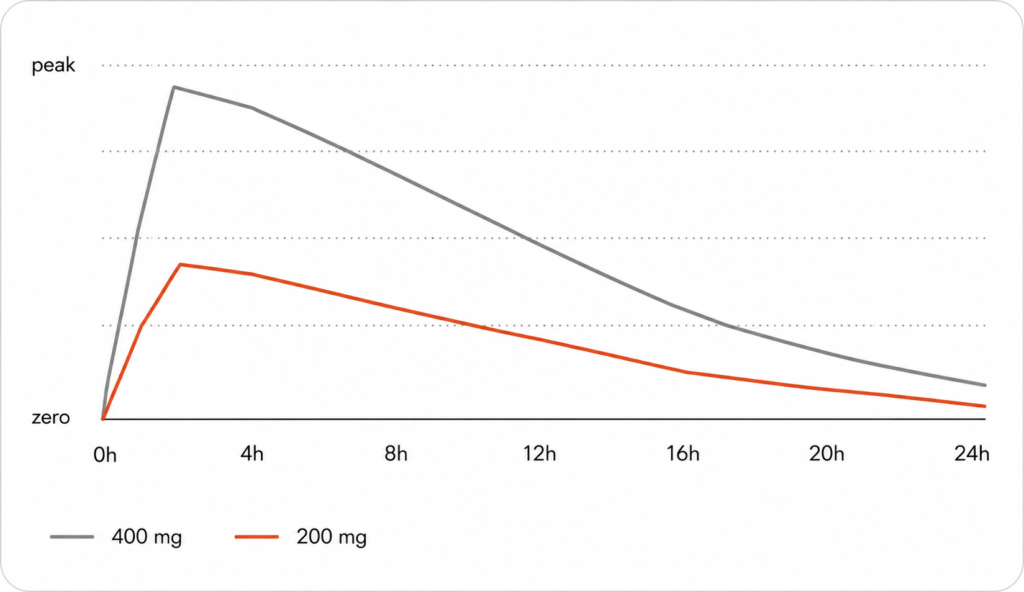
Doubling the dose roughly doubles plasma exposure, and with it side effect exposure, without a matching increase in target engagement.
At 200 mg the relevant transporters are already substantially occupied. Adding drug does not add proportional target engagement. What it reliably adds is exposure to side effects, which scale with plasma concentration in a way that benefit does not.
The honest summary
Modafinil produces real, replicable, domain specific improvements in cognition in healthy rested adults, concentrated in executive function and, on complex tasks, in attention and learning. The improvements are modest. They are larger under sleep deprivation, larger in lower performers, and accompanied in some studies by impairment of divergent creative thinking.
The distance between “statistically significant improvement on the Stockings of Cambridge task” and “makes you smarter” is substantial. Most popular coverage collapses it.
Does modafinil improve cognition in healthy people?
Yes, measurably, but the benefit is domain specific and modest. It concentrates in executive function, and extends to attention and learning on more complex tasks.
How large is the effect?
Modest in rested adults, and substantially larger under sleep deprivation. The gap between those two conditions is the single largest source of overstatement about this drug.
Does a higher dose produce more benefit?
There is little reason to expect it to. PET imaging found that 400 mg did not meaningfully increase striatal dopamine transporter occupancy over 200 mg, while side effect exposure does scale with concentration.
Does modafinil make people more creative?
Some studies report the opposite: impairment of divergent creative thinking, meaning the cognitive profile is not uniformly positive.
Who benefits most?
Lower performing individuals, and people who are sleep deprived. Benefits diminish in high performers who have less room to gain.
Continue reading
References
- 1. Battleday RM, Brem AK. Modafinil for cognitive neuroenhancement in healthy non-sleep-deprived subjects: A systematic review. European Neuropsychopharmacology. 2015.
- 2. Volkow ND et al. Effects of modafinil on dopamine and dopamine transporters in the male human brain. JAMA. 2009.
- 3. Franke AG et al. Methylphenidate, modafinil, and caffeine for cognitive enhancement in chess: A double-blind, randomised controlled trial.
- 4. Wesensten NJ et al. Performance and alertness effects of caffeine, dextroamphetamine, and modafinil during sleep deprivation.