
Home / Comparisons / Modafinil vs Vyvanse
Modafinil vs Vyvanse
This page is a reference summary of published evidence and regulatory documents. It is not a substitute for individual medical advice, and it is not a recommendation to take or avoid any medicine.
Medically reviewed by Dr. Sofia Lindqvist, · Last reviewed 11 August 2026
Educational information, not medical advice. Both drugs are prescription only controlled substances in the United States. Vyvanse is Schedule II and carries an FDA boxed warning for abuse, misuse, and addiction. Neither drug is approved for cognitive enhancement in people without a diagnosed condition.
These two drugs share no approved indication. Modafinil is approved for narcolepsy, obstructive sleep apnea, and shift work disorder. Vyvanse is approved for ADHD and binge eating disorder. There is no condition for which both are approved, which makes this an unusual comparison: for most clinical situations, only one of them is a candidate.
Where they do resemble each other is duration. Both are long acting, both are taken once daily, and both produce a smoother profile than immediate release stimulants. That surface similarity is why they get compared, and it obscures how different they are pharmacologically.
On this page
At a glance

0
shared approved indications
IV vs II
DEA schedule
1
boxed warning, on Vyvanse
10–15 h
both act across a working day
The comparison turns on one fact and one similarity. The fact is that no condition is approved for both. The similarity is duration, and it is the reason the two are compared at all.
Side by side
| Modafinil | Vyvanse | |
|---|---|---|
| Active drug | Modafinil | Lisdexamfetamine |
| Class | Eugeroic (wakefulness promoting agent) | Amphetamine, prodrug |
| FDA approval | 1998 | 2007 |
| Approved for | Narcolepsy, OSA, shift work disorder | ADHD, binge eating disorder |
| Narcolepsy | Approved | Not approved |
| ADHD | Not approved | Approved |
| DEA schedule | Schedule IV | Schedule II |
| Boxed warning | None | Yes |
| Mechanism | Weak dopamine reuptake inhibition, plus orexin and histamine effects | Transporter reversal and reuptake blockade, after enzymatic conversion |
| Active on ingestion | Yes | No, requires conversion |
| Onset | 2 to 4 hours to peak | 1 to 2 hours |
| Duration | About 15 hour half life | 10 to 14 hours |
| Euphoria potential | Low | Higher |
| Cardiovascular effect | Modest | Greater |
| Pregnancy | Contraindicated in EU, UK, Canada, Australia | Requires clinical assessment |
The indication gap
This is the most important thing on the page, and it is what most comparisons of these two drugs skip.
Adderall at least overlaps with modafinil at narcolepsy, since both carry that indication. Vyvanse does not. Despite being an amphetamine like Adderall, Vyvanse is approved for ADHD and binge eating disorder only.
| Indication | Modafinil | Vyvanse | Adderall |
|---|---|---|---|
| Narcolepsy | Approved | Not approved | Approved |
| Obstructive sleep apnea sleepiness | Approved | Not approved | Not approved |
| Shift work disorder | Approved | Not approved | Not approved |
| ADHD | Not approved | Approved | Approved |
| Binge eating disorder | Not approved | Approved | Not approved |
No row carries both modafinil and Vyvanse, which is why the choice between them is rarely a real clinical choice.
So the practical situations are:
Someone with narcolepsy is not choosing between these. Modafinil is approved; Vyvanse is not. If an amphetamine is wanted for narcolepsy, Adderall is the one with the indication.
Someone with ADHD is also not straightforwardly choosing between them. Vyvanse is approved, with a substantial evidence base. Modafinil is not approved for ADHD anywhere, and its evidence base in ADHD is considerably thinner.
Someone without either diagnosis is in the situation where these feel like competing options. Neither drug is approved for that use, neither has been evaluated by any regulator for it, and it is the context in which both carry the most risk relative to benefit.
Neuron releases dopamine/norepinephrine
Normal firing
Methylphenidate blocks reuptake transporters
Clearance is slowed
Neurotransmitter lingers in the synapse
Effect scales with existing release
Amphetamine enters the neuron
Crosses the membrane and enters vesicles
VMAT2 disrupted, vesicles empty into cytoplasm
Stored neurotransmitter is released
Transporters run in reverse
Neurotransmitter actively pumped into the synapse
Amphetamine: transporter reversal plus vesicular disruption.
The practical consequence is that amphetamine produces a larger rise in synaptic catecholamines, and one less dependent on the neuron’s own firing. Methylphenidate amplifies what is already happening. Amphetamine drives the process directly.
Mechanism
The two drugs raise catecholamines by entirely different routes, and the difference is one of magnitude and directness.
Modafinil weakly inhibits the dopamine transporter, meaning dopamine already released into the synapse stays there longer. Its binding affinity is low compared with classical stimulants, and much of its effect appears to come from downstream activation of orexin and histamine systems rather than from transporter binding alone. It is active as soon as it is absorbed.
Can Vyvanse be prescribed for narcolepsy?
Not on label. Vyvanse is approved for ADHD and binge eating disorder. Among amphetamines, Adderall is the one carrying a narcolepsy indication.
Is modafinil weaker than Vyvanse?
Vyvanse produces a larger rise in synaptic catecholamines, so in terms of pharmacological effect size, yes. But they are approved for different conditions, and Vyvanse’s greater potency comes with Schedule II status and a boxed warning that modafinil does not carry.
Which lasts longer?
They are comparable. Modafinil’s half life is around fifteen hours; Vyvanse produces effects for ten to fourteen. Both are once daily and both risk disrupting sleep if taken late.
Is Vyvanse safer than Adderall?
The prodrug design reduces the practical risk of misuse by non oral routes and prevents a rapid euphoric onset. Both remain Schedule II with boxed warnings. The design reduces one pathway to misuse rather than eliminating risk.
Which is better for focus?
Neither is approved for improving focus in people without a diagnosed condition, and neither has been evaluated by regulators for that purpose. Persistent difficulty concentrating warrants a medical evaluation, because it can indicate ADHD, a sleep disorder, depression, or thyroid dysfunction, and self selecting a stimulant tends to delay identifying whichever it is.
Modafinil absorbed
already active
DAT inhibition
weak, reuptake slowed
Orexin + histamine ↑
hypothalamus
Sustained wakefulness
Vyvanse swallowed
inactive prodrug
Enzymatic cleavage
lysine removed in blood
Dextroamphetamine
transporter reversal
Large catecholamine release
Modafinil acts on absorption. Vyvanse has to be cleaved in the blood before any amphetamine exists at all.
Vyvanse is lisdexamfetamine: dextroamphetamine chemically bonded to the amino acid lysine. In that form it is pharmacologically inactive. Enzymes in the blood cleave the lysine and release dextroamphetamine, which then acts as an amphetamine does. It reverses transporter direction, actively pumping dopamine and norepinephrine out of neurons into the synapse, and disrupts vesicular storage, making stored neurotransmitter available for reverse transport.
Modafinil slows the clearing of what is already there. Vyvanse drives release directly. That is why Vyvanse produces a substantially larger rise in synaptic catecholamines, and one less dependent on the neuron’s own activity.
Gentler → more forceful
Caffeine
Modafinil
Ritalin
Vyvanse
Relative pharmacological force, on an illustrative scale. Scheduling tracks this ordering, though it is a regulatory judgement rather than a measurement.
The prodrug design and what it changes
Vyvanse’s conversion step is the feature that distinguishes it from other amphetamines, and it is worth understanding because it produces a profile closer to modafinil’s than Adderall’s is.
Because conversion happens enzymatically in the blood rather than depending on absorption, the rate is relatively constant regardless of how the drug is taken. Crushing, dissolving, insufflating, or injecting it does not produce a faster onset, because the rate limiting step occurs after the drug is already in the bloodstream.
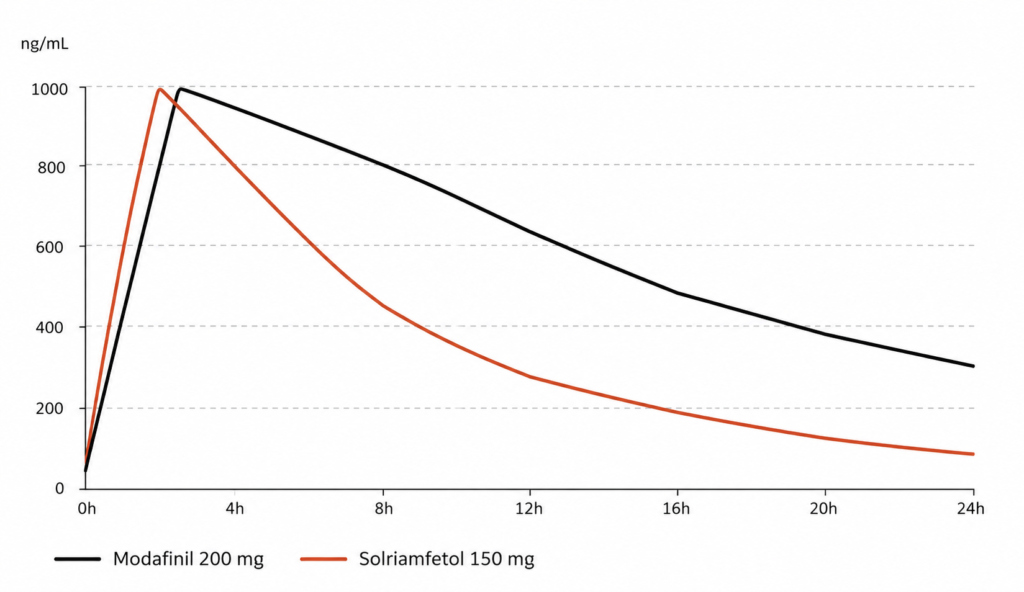
Illustrative plasma curves after morning dosing. Vyvanse climbs gradually because conversion sets the pace; modafinil peaks and then declines slowly across a long half life.
Rate of onset is a well established determinant of a drug’s reinforcing efficacy. Vyvanse’s design removes the ability to produce a rapid one, which is why it is sometimes preferred where misuse or diversion is a specific concern.
This narrows but does not close the gap with modafinil. Vyvanse remains Schedule II with a boxed warning. Modafinil is Schedule IV with neither. Taken orally at high doses, Vyvanse still delivers dextroamphetamine, and dependence remains possible.
Modafinil
20
Schedule IV, no boxed warning
Vyvanse
62
Schedule II, conversion limits rapid onset
Adderall IR
88
Schedule II, fast onset by any route
Relative euphoria and misuse potential, illustrative. The prodrug step lowers Vyvanse below immediate release amphetamine without bringing it near modafinil.
Duration
This is where the two are genuinely similar, and it is why they get compared.
Modafinil 200 mg
1–15 h
long tail, can reach bedtime
Vyvanse 50 mg
1.5–14 h
gradual rise, gradual decline
Adderall IR 20 mg
0.5–6 h
for contrast
0h
4h
8h
12h
16h
Approximate window of useful effect after a morning dose.
Modafinil has an elimination half life of roughly fifteen hours. Vyvanse produces effects for ten to fourteen. Both are once daily, both cover a full working day, and both produce a gradual decline rather than the sharp offset of immediate release stimulants.
The practical consequence is the same for both: a dose taken late in the day interferes with that night’s sleep. Neither drug is forgiving of timing errors in the way a four hour stimulant is.
Safety
The profiles differ in kind, not just degree.
Boxed warning, Vyvanse
Vyvanse carries an FDA boxed warning for abuse, misuse, and addiction, and notes serious cardiac events. Modafinil carries no boxed warning.
Vyvanse’s principal risks are dependence and cardiovascular. Appetite suppression and weight loss are common and more pronounced than with modafinil. Discontinuation after sustained use can produce a recognised withdrawal syndrome.
Modafinil’s distinctive risk is dermatological. Serious skin reactions including Stevens Johnson syndrome, toxic epidermal necrolysis, and DRESS have been reported. These are rare but can be fatal, which is why the guidance is to stop at the first sign of rash rather than monitor it. This is not a characteristic risk of Vyvanse.
| Risk | Modafinil | Vyvanse |
|---|---|---|
| Dependence and withdrawal | Low, no boxed warning | Boxed warning, recognised withdrawal |
| Cardiovascular load | Modest | Greater |
| Appetite and weight | Occasional reduction | Common suppression and weight loss |
| Serious skin reactions | Rare but characteristic | Not characteristic |
| Pregnancy | Contraindicated in EU, UK, Canada, Australia | Requires clinical assessment |
| Psychosis and mania | Reported in susceptible individuals | Reported in susceptible individuals |
Modafinil also carries pregnancy contraindications adopted by regulators in the EU, UK, Canada, and Australia, together with a CYP3A4 interaction that reduces hormonal contraceptive efficacy. Those two facts compound, and the combination has no direct equivalent in Vyvanse’s profile.
Modafinil for ADHD
Because a substantial share of people making this comparison have ADHD and are asking whether modafinil is an option, it is worth answering directly.
Modafinil is prescribed off label for ADHD by some clinicians, usually where stimulant intolerance, cardiovascular concerns, anxiety comorbidity, or a history of substance use disorder makes an amphetamine undesirable. Its lower abuse potential is the main reason it gets considered.
But it is not approved for ADHD in any country, and more research is needed to establish whether it is an appropriate treatment. Available discussion suggests it may suit inattentive presentations or adults better than it suits severe hyperactivity, where the larger dopaminergic effect of amphetamine appears to matter more.
Vyvanse in ADHD
92
approved, guideline supported
Modafinil in ADHD
24
off label, smaller and less consistent trials
Relative depth of the ADHD evidence base, illustrative. Approval, guideline support and trial volume all sit on the amphetamine side.
Vyvanse has the approval, the guideline support, and a far larger evidence base for ADHD. Modafinil is a considered alternative in specific circumstances, not an equivalent option, and any such switch requires clinical supervision.
Combining them
Not recommended. Both raise synaptic catecholamines, so the combination compounds cardiovascular load, anxiety, and insomnia without a corresponding gain. There is no established dosing framework for the combination and no evidence it outperforms either drug alone.
Frequently asked questions
Can Vyvanse be prescribed for narcolepsy?
Not on label. Vyvanse is approved for ADHD and binge eating disorder. Among amphetamines, Adderall is the one carrying a narcolepsy indication.
Is modafinil weaker than Vyvanse?
Vyvanse produces a larger rise in synaptic catecholamines, so in terms of pharmacological effect size, yes. But they are approved for different conditions, and Vyvanse’s greater potency comes with Schedule II status and a boxed warning that modafinil does not carry.
Which lasts longer?
They are comparable. Modafinil’s half life is around fifteen hours; Vyvanse produces effects for ten to fourteen. Both are once daily and both risk disrupting sleep if taken late.
Is Vyvanse safer than Adderall?
The prodrug design reduces the practical risk of misuse by non oral routes and prevents a rapid euphoric onset. Both remain Schedule II with boxed warnings. The design reduces one pathway to misuse rather than eliminating risk.
Which is better for focus?
Neither is approved for improving focus in people without a diagnosed condition, and neither has been evaluated by regulators for that purpose. Persistent difficulty concentrating warrants a medical evaluation, because it can indicate ADHD, a sleep disorder, depression, or thyroid dysfunction, and self selecting a stimulant tends to delay identifying whichever it is.
Continue reading
References
- 1. FDA. Provigil (modafinil) prescribing information.
- 2. FDA. Vyvanse (lisdexamfetamine dimesylate) prescribing information.
- 3. Cortese S, et al. Comparative efficacy and tolerability of medications for ADHD in children, adolescents, and adults: a systematic review and network meta-analysis. Lancet Psychiatry. 2018.
- 4. DEA. Drug Scheduling.
- 5. EMA. Modafinil-containing medicines: Article 31 referral outcome.